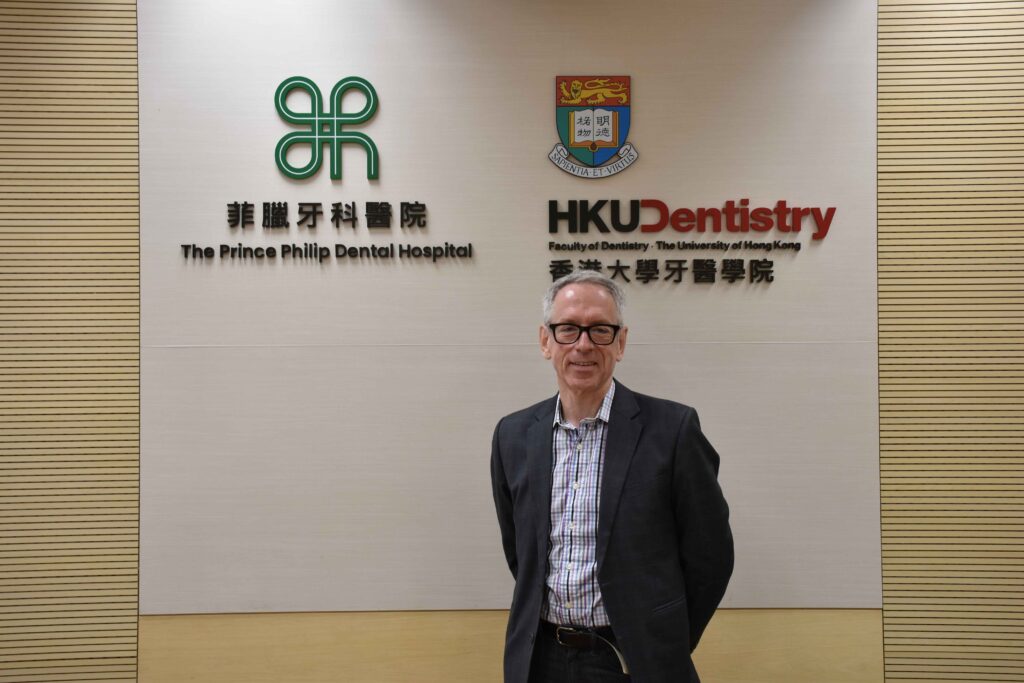
Putting Students First
In an extensive interview, Professor Michael George Botelho traces his path to becoming a leading educational innovator in Hong Kong and explains how the road to healthy, effective student-centred learning is founded in empathy, communication and putting people first.
It has been a long journey for Professor Michael George Botelho that has led to The University of Hong Kong (HKU) and roles as Clinical Professor in Prosthodontics and Associate Dean of Student Wellness, with a reputation for driving pedagogical reform as an educational innovator and a supporter of students becoming partners in their own collaborative learning pathway.
As a champion of an active learning approach that is student‑centred, Botelho encourages students to interact and declare their knowledge, thereby ensuring every student has a voice. He has also expanded his scholarship into dental‑student wellness and mental health.
The career of this seasoned educator began in the United Kingdom, where he graduated from the London Hospital Medical College and went into general dentistry practice. He then worked in Zimbabwe for a year, an experience that he describes as a “fabulous adventure,” before returning to the United Kingdom to complete his master’s degree. Looking to develop a nascent interest in teaching, he worked in South Africa for several years before he got the call from HKU that would change his life and see him land in Hong Kong on 5 November, 1995.
“I have been here since, and that’s where I finished my PhD and established my education career and pathway,” Botelho comments.
Looking back, Botelho says that he was lucky to have “good schooling and a good upbringing.” He adds that he initially considered medicine as a vocation because of family connections, but eventually decided it was not for him and went into dentistry. Though he says he somewhat “stumbled” into education, he also recalls a number of teachers who inspired him to pursue a career in academia.
He mentions a charismatic postgraduate studies Program Director who saw the light of an educator in him. He also talks about the positive impact of a passionate secondary school biology teacher who was “approachable” rather than “hierarchical,” while a water polo coach instilled in him a sense of drive. He says they essentially shaped his view of what kind of teacher he wanted to become.
Their influence and later experiences in the field taught Botelho that teaching is not just about the dissemination of information, but also the holistic development of the individual. He admits that his primary goal now is to be an educator, not just a teacher, which means looking at the learning process from the perspective of the learner.
‘Sage on the Stage’
This approach led to one of the most significant shifts in his career. In terms of a teaching style, he moved away from the “sage on the stage” model, where the teacher is the main authority and typically lectures to a passive class. Instead, he advocates for being a “guide on the side,” who encourages students to be more interactive, peer-teach, and actively declare their knowledge.
Instead of being an “orator giving a monologue to the class,” Botelho says, a more active learning environment is taking “any opportunity that you have to get the students to talk and explain their knowledge or identify misconceptions. For me, this is a much more meaningful learning encounter than somebody standing up and telling them how to do it.”
Addressing the common stereotype about Asian learners being passive in the classroom, Botelho is quick to call this a “misnomer.” He praises Hong Kong students for being exceptional at group work and active learners when provided with the right environment and strategies. To ensure every student has a voice, he employs a Think-Pair-Share strategy to boost participation and interactivity. By wandering around the class with a microphone and asking targeted questions — especially to students on their phones — he ensures the learning encounter becomes a meaningful dialogue.
Central to Botelho’s teaching philosophy is the application of the learning sciences, which looks at evidence-based literature on how people actually learn. This enables the design of better teaching and environments for personalised learning, collaborative activities, gamification, learning analytics and teacher training.
He emphasises several key concepts to help students achieve more. For example, “space practice” generally avoids “block teaching” and instead spreads learning out over time to allow for better assimilation and retention. “Retrieval practice” uses frequent quizzes to identify knowledge gaps and reinforce memory; while “elaboration” creates opportunities for students to talk through their knowledge, which inevitably deepens their understanding.
A firm supporter of the Socratic approach, Botelho places an emphasis on the “special power” of questions. He asks leading questions to help students identify their own misconceptions and build knowledge frameworks themselves. While this process can take longer, Botelho says it ensures students remember the material better because they “built that knowledge themselves.”
Pedagogical Goals
He believes there is often a “technical transition gap” in healthcare education between learning theory in a lab and applying it to a real patient. To bridge this, he created a new level in the clinical skills framework known as “Miller’s pyramid,” which assesses clinical competence. While traditional models focus on knowing and showing, his construct emphasises the cognitive preparation required to solve problems and make clinical decisions in real-life situations.
To support this, he uses Vicarious Learning Dialogue Videos to record dialogue and highlight “teaching moments,” as problems are solved together through communication. Other students can then watch these videos to learn vicariously through peer experiences.
To support these pedagogical goals, Botelho has developed Vox, a novel e-learning platform used across the university. Unlike traditional platforms that only deliver content, Vox is designed for interaction and dialogue. It facilitates a “flipped classroom” model, where students engage with content — such as videos, worksheets, or readings — before class. This leaves classroom time for deep discussion and problem-solving.
The next iteration of this platform will include professional and personal development portfolios. These tools are designed to develop student agency and autonomy, allowing them to track their achievements and reflect on their personal well-being in real-time.
One of Botelho’s most provocative positions as an educator is moving away from the final end-of-year exam as the sole determinant of a learning outcome. He argues that waiting until the end of the year to assess students is “too late to be providing remedial support.” He compares this to diagnosing a patient after they have had a heart attack, rather than identifying factors like the poor diet that led to it.
Botelho instead advocates for programmatic assessment, which is a system of continuous feedback and “mastery learning.” In his courses, students must achieve a 70% pass mark on weekly quizzes to demonstrate their proficiency. If they engage seriously with the platform and pass these continuous assessments, then he floats the idea that in the future, a traditional final exam may no longer be necessary.
Prioritising Student Wellness
Botelho also addresses the diversity of student wellness needs. He says that he noticed there was a gap in how the university supported students. This is essentially why the position of Associate Dean of Wellness was proposed and created for him in 2025. Botelho believes every faculty should have a dedicated wellness lead to cope with an increasing number of students who have wellness issues.
Among his many initiatives are mentorship programs that transition the role of “personal tutor” to “personal mentor” and provide coaching on personal, academic, and clinical goals. Meanwhile, “near-peer mentors” draw on senior students to support juniors, as they best understand the pressures of the curriculum. Botelho adds that a university-wide platform (wellness.hku.hk) has also been set up to solve the emotional, social, physical, and financial well-being issues that face students.
Looking to the future, Botelho sees both challenges and opportunities. While he admits the rise of AI will inevitably impact clinical practice and the role of the teacher, he believes the core of education will remain “human-focused.” For him, the most important attributes of an educator are empathy, patience, enthusiasm, and the ability to see things from the student’s perspective.
His advice to fellow teachers and aspiring professionals is to focus on impact. “How might you have impact within your course, within your faculty, within your life?” he asks. The answer, he says, is to be a ”change agent” who prioritises the well-being and active engagement of learners. He insists educators can create a more effective, compassionate, and meaningful learning environment for the next generation.
Through his blend of rigorous learning science and innovative technology, Botelho serves as a powerful example of how a change agent can influence an entire institution. Even so, his journey to this point reminds us that the more traditional and softer skills of empathy, communication and putting people first truly define an exceptional educator.