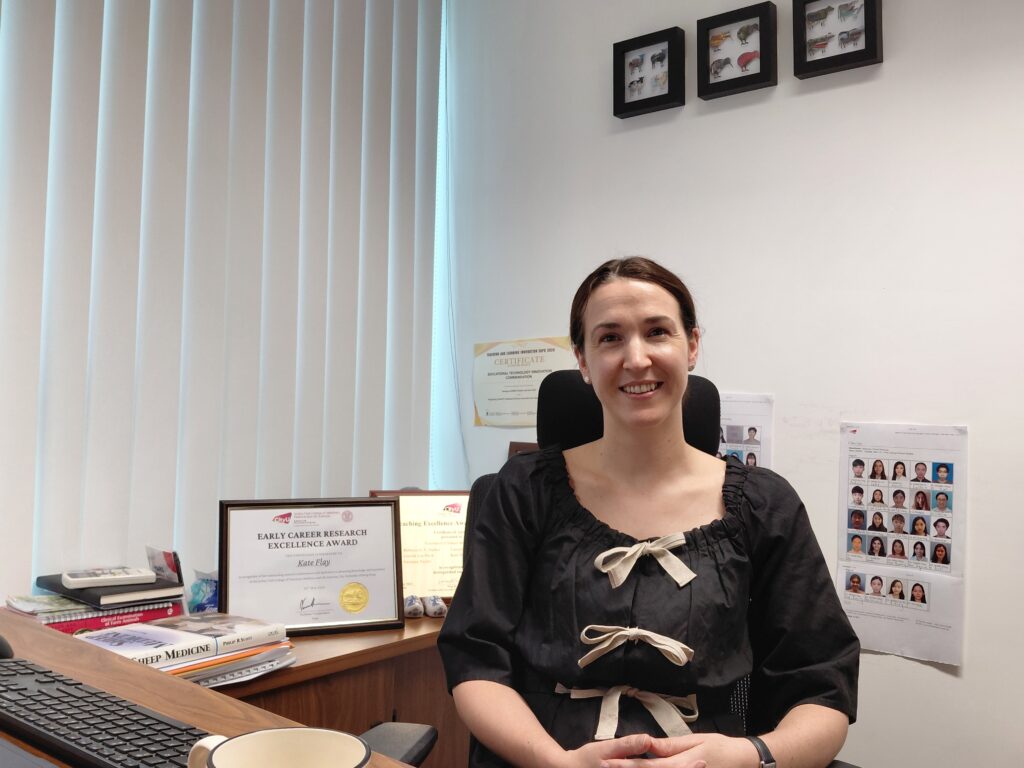
An Interview with Professor Kate FLAY, leader of Veterinary Education utilising Technology (V.E.T) Team of the City University of Hong Kong (Finalist of UGC Teaching Award, 2024)
Professor Kate FLAY, who led CityUHK’s V.E.T. team to become a finalist of the 2024 UGC Teaching Award, was determined to become a veterinarian since a young age. Growing up on her family’s farm in rural New Zealand where the nearest small town was 40 minutes’ drive away, the only child of the family spent much time with the three thousand ewes and several hundred cows on the farm which was surrounded by other farms. Seeing veterinarians heal animals and always being in love with learning, the young Kate embarked on the journey to realize her aspirations early in life.
As a high school student, she accumulated work experience at veterinary clinics to enter the Bachelor’s program in Veterinary Science at Massey University. Upon graduation with distinction in 2012, she worked as a veterinarian for three years before becoming a full-time lecturer at Massey while studying part-time for her PhD on wastage and productivity of commercial ewes.
Excited by the opportunities offered by CityUHK’s Jockey Club College of Veterinary Medicine and Life Sciences (JCC), she joined the new Department of Veterinary Clinical Sciences as an Assistant Professor in 2020. To date, she has garnered accolades including JCC’s Early Career Research Excellence Award and CityUHK’s Teaching Excellence Award.
Teaching innovation
In 2024, she led the Veterinary Education utilising Technology (V.E.T.) Team of CityUHK to become a finalist of the UGC Teaching Award. Their technological innovations involve life-size model animals to help students practice and demonstrate clinical skills.
“After reading textbooks and skills sheets and watching videos about clinical skills, students ‘know’ how to do it — but can they actually ‘do’ it?” Professor Flay elaborated that vet students need to show they can really ‘do’ it and bridge the gap between preclinical and clinical practices, as Miller’s Pyramid states that ‘knows’, ‘knows how’ and ‘shows how’ should be followed by ‘does’.
At the College’s Clinical Skills Lab, life-size model animals play exactly this bridging role. On top, they promote and prioritize ethical use of animals and reduce reliance on live animals in veterinary teaching.
With life-size model sheep for instance, students can practice injection skills that include determining the right size of needles and syringes, and if a vacutainer holder is needed. CityUHK’s team purchased the body of the model sheep online from manufacturers, and made modifications so that there is now a zip in the back for taking IV tubing in and out, and there is a little pad in the front around the vein. The team inserted model jugular veins into the model sheep. “Using landmarks of where the jugular would be, students can palpate, feel it and raise the jugular to collect a blood sample.”
Life-size cattle, with a model calf inside, are set up for calving so that students can practice and apply head and leg ropes if the calf needs assistance with birthing. There are also plenty of other models for a range of education needs, including some novel ones that are made by team members.
The team has made two categories of models: Low-fidelity models are used for teaching and learning procedural skills, such as basic suture patterns, where repetitive practice is essential. High-fidelity models, which largely assimilate and share the same characteristics as real animals, are used for practising intricate processes such as more complex surgical procedures.
“Students will only work on real animals later when they are more relaxed and confident; they do not do so for the first time as it would be stressful for both the students and the animals. For instance, blood sampling can be painful and students want to make sure they are doing it exactly right on live animals.”
The time frame, with which students in the six-year Bachelor of Veterinary Medicine (BVM) move from models to real animals, depends on their skills and the practices. For non-invasive procedures such as popping muzzles on dogs, junior students can move from models to real dogs. Invasive injections and basic surgeries are done by third-year students for the first time on models. Fourth-year students, after demonstrating competency, will start doing their first live animal surgeries that are clinically indicated. They have to pass a number of barrier assessments before progressing to live animal stage. Then all of the final year is about work-integrated learning in clinics.
Yet another innovation is a series of large boxes, orderly arranged on the shelf by the wall of the lab, with open access to students. Each box, catered for the practice of a specific clinical skill, has a QR code that links to JCC’s online Clinical Skills Hub with step-by-step instructions. In the box is the equipment for practising. Student can easily pick up boxes and independently practice in advance all major skills from suturing to sterile milk sampling in cattle.
The team has shared their innovations with vet schools globally, while employers state that their students and graduates are well-prepared for clinical practices. In future, she aspires to incorporate Virtual Reality into teaching, as well as move towards more comprehensive simulations and integrate the models into complex clinical scenarios.
Other core members of the team at CityUHK include Professor Vanessa BARRS, Professor Eloi GUARNIERI, Professor Ákos KENÉZ and Mrs Susanna TAYLOR. There are also significant contributions from other teaching and administrative staff, technical officers, as well as student interns.
Continuing professional learning
As the Assistant Dean of Teaching and Learning as well as the Bachelor of Veterinary Medicine Programme Leader, Professor Flay is dedicated to cultivating an enriching atmosphere of teaching and learning. She launched the Veterinary Education Journal Club in which participants take turns to lead and present on a selected topic on education and related journal articles. Faculty members, teaching staff and clinicians join on a totally voluntary basis with great enthusiasm.
In the young and forward-looking school with passionate members, she also runs the Continuing Professional Development and Pedagogy initiative with workshops hosted by external speakers, education-related conferences, online clinical skills forum, as well as sharing sessions among the global veterinary education community. Topics range from pre-clinical and clinical education, student well-being and support etc.
Students as top priority
Professor Flay thinks it would be nice if universities make more efforts to strike a balance between research and education. “To be successful under the current system, we’ve got to do it all. We’ve got to do it all,” she repeated. “If I really have to pick one, I enjoy teaching more and I love working with my students. That is the part that brings me joy and makes me want to come to work. My teaching takes the highest priority in my current role.”
Apart from recognitions from HKTEA, she hopes there could be more teaching awards to recognize more excellent educators, since there are many.
Despite challenges from AI, she believes the core role of educators remain unchanged: empowering students to think critically, solve problems, and apply knowledge. For veterinary science in particular, it is crucial to develop students’ critical appraisal ability and clinical reasoning.
She does so by asking appropriate questions in case-based, small-group discussions so that students can come up with different answers that can be justified. “Educators act as guides. We need to think logically and articulate our thought patterns to facilitate their learning processes and help them go from here to there.”
Similarly, she believes good vets are not only about knowledge and technical skills, but communication skills, resilience, and ability to deal with challenges and changes.
For young people who aspire to be vets, she advises that they do internships and research to find out their real passions. Apart from the love of animals, they also need to be prepared for their deaths. “It is only realistic to be aware that there is euthanasia, and it is not always the best thing to save every animal,” noted the vet who has been with animals all her life.